02. February 2026
1st Place at the European Commission Drupal AI Hackathon “Play to Impact 2026”
From Code to Clarity: Rethinking Hackathons in the Age of AI
Author: Shibin Das, Senior Backend Developer
Hackathons have always meant one thing to me: code, caffeine, and controlled chaos. At the European Commission Drupal AI Hackathon Play to Impact 2026, however, it was about much more than a working demo. Our goal was to show how AI agents can concretely, tangibly, and responsibly support editorial processes in Drupal and to position Drupal as an intelligent content hub that collaborates with editors rather than just working for them.
Setting the Stage: The Drupal AI Hackathon 2026
For context, my name is Shibin Das (D34dMan), and I’m part of the backend engineering team at Factorial GmbH. I had the opportunity to collaborate closely with my colleague David Galeano (gxleano), who is also part of the backend team, during this work. I’m also the founder of FlowDrop, a visual workflow-builder JavaScript library, along with a Drupal project that goes beyond workflow editing into orchestration, auditing, and logging.
The “Play to Impact” Drupal AI Hackathon 2026 brought together brilliant minds from across Europe to help shape the future of the European Commission’s digital ecosystem. Over the course of the two-day in-person event, developers, designers, and digital innovators worked side by side to create smarter, faster, and more open digital solutions built with Drupal and AI.
Although the hackathon itself spanned two days, it actually began a week earlier with a virtual kickoff. That detail may sound minor, but it made a huge difference. We met our teammates early, started exchanging ideas, and arrived on day one already aligned as humans not just as developers.
Day One: This Is Not Your Usual Hackathon
Very quickly it became clear that this was different. The first half of the first day was not about code at all, but about:
- Getting to know the team properly
- Understanding the business requirements
- Asking uncomfortable but necessary why questions
At this point we also made a conscious decision for Challenge 1: AI Agents for Content Editors. While the second challenge focused on AI powered no code site building, we chose the topic that addressed a concrete, everyday problem: the editorial day to day work in Drupal.
Only then did we start brainstorming. We shared ideas, discussed approaches, and had a rough plan before lunch. That alone felt like we were breaking an unofficial hackathon rule.
Then came the most valuable moment of the event: 👉 a real conversation with a user.
That conversation completely changed our perspective.
More than half of our supposedly good ideas were discarded. Not because they were technically infeasible, but because they did not deliver real value from a usage or business perspective. Instead, the core question emerged: Can AI agents in Drupal truly make editorial work easier?
Our task was to build a proof of concept that shows how AI agents can support editorial workflows, from content audits to planning and optimization. The goal was to turn Drupal into an intelligent content hub that works with editorial teams, not just for them.
On the same day we presented our concept to the client. The result was another round of tough prioritization. Features were removed, new ones added. Everything was realigned around genuine impact, with a focus on automation, ECA integration, data ethics, governance, and human in the loop collaboration.
By the end of day one, it was clear: this hackathon was about impact, not about producing as much output as possible.
Day Two: Parallel, Focused, Aligned
By day two, we were on our heels in the best possible way. Because we had already aligned on what we were building and why, we could split the team effectively:
- Half focused on development
- Half focused on demos and presentation
No chaos. No last-minute philosophical debates. Just execution.
This was also where AI-assisted development truly shined.
Generating code with AI significantly accelerated our work not just for implementation, but for:
- Rapid prototyping
- Demo preparation
- Presentation content
- Exploring and discarding ideas quickly
The gap between idea and working solution has never been smaller. And that shift fundamentally changes how hackathons and honestly, product development in general should be approached.
We’re no longer forced to spend most of our time translating ideas into code. Instead, we can spend that time listening, validating, and iterating on business needs.
Throwaway solutions are no longer a failure they’re a feature.
The Mental Shift (and the PTSD 😅)
I won’t sugarcoat it: adjusting to this new reality wasn’t easy.
There was genuine developer PTSD involved. The instinct to “just start coding” is deeply ingrained. Letting go of that and trusting a process that prioritizes understanding over implementation felt…wrong at first.
But by the end of the hackathon, the status quo had shifted.
We experienced a level of collaboration with business stakeholders that would have felt unimaginable just a few years ago. AI didn’t replace developers it freed us to operate at a higher level.
The Result
In the end, our consistent focus on impact paid off. As Team Token Burners, we were able to demonstrate how AI agents can directly and tangibly support editorial workflows in Drupal, from content audits to planning and optimization, embedded within existing processes. What mattered most was not the technology itself, but the approach: AI as a copilot that takes over routines, while decisions, responsibility, and quality consciously remain with humans.
🏆 First place at the European Commission Drupal AI Hackathon Play to Impact 2026
This success was true teamwork.
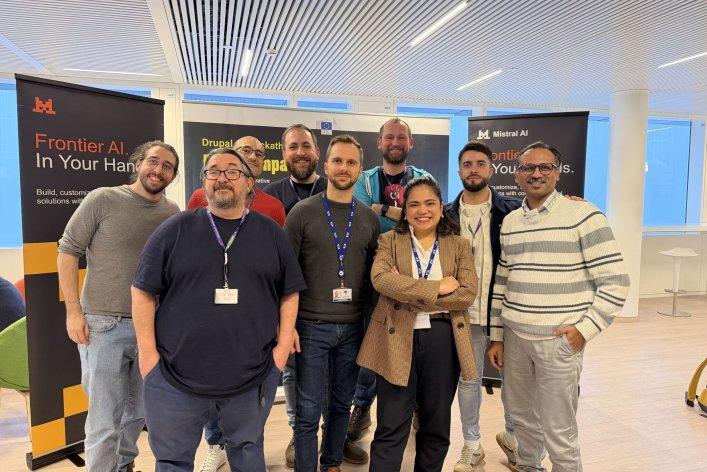
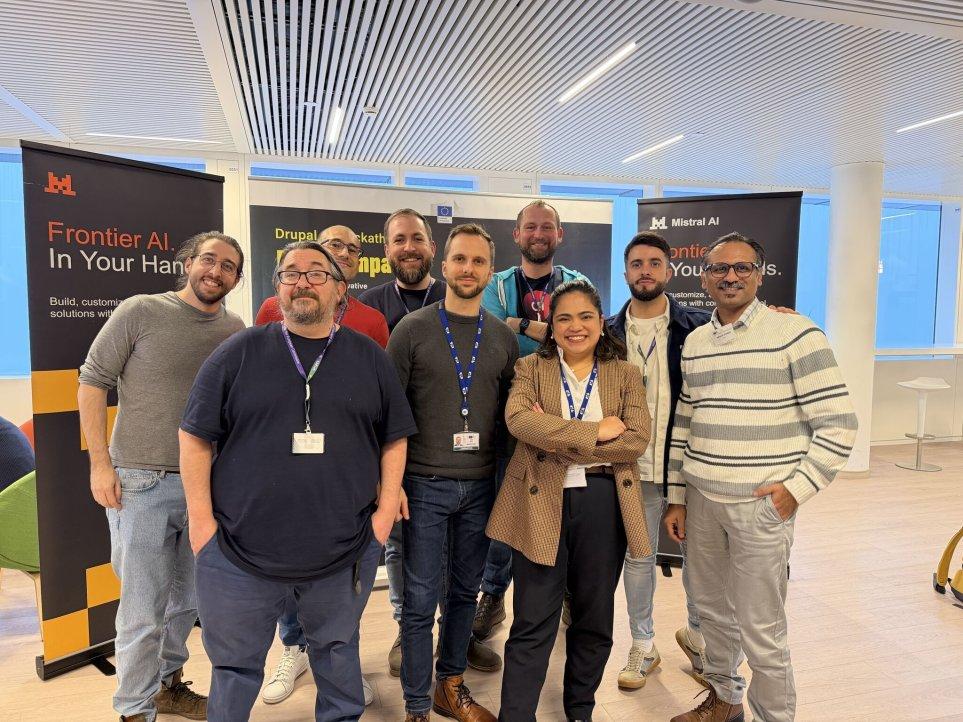
Team Token Burners: Adam Nagy (Team Lead), David, Henk, Ziarla, Imanol, Francesco, Aarón, Enrique, and me, Shibin Das.
Beyond the competition, we were able to give concrete value back to the Drupal ecosystem:
Improved Modules
- FlowDrop
- FlowDrop AI Provider
New Modules Contributed
- FlowDrop AI Agent
- FlowDrop Node Session
This wasn’t just a hackathon project it was real, usable work.
A Well-Thought-Out Event
None of this would have been possible without exceptional organization and facilitation.
Huge thanks to:
- The Drupal Community of Practice organizing team at EC and EUIBAs
- Sabina La Felice, Monika Vladimirova, Antonio De Marco, and Rosa Ordinana-Calabuig
- NTT DATA’s Innovation team for hands-on facilitation throughout ideation, prototyping, and pitching
- The jury members for their thoughtful feedback
- Sponsors and ecosystem partners including Drupal AI Initiative, amazee.io — Drupal AI, Mistral AI, and DevPanel
This hackathon wasn’t just well organized it was intentionally designed for the future we’re stepping into.
Final Thoughts: What AI Means for the Future of Drupal Hackathons
This experience reinforced something I strongly believe: In an AI-assisted world, the true bottleneck is no longer code it’s clarity.
The ability to understand, validate, and iterate on business needs is becoming more valuable than raw implementation speed. And when hackathons are designed with that reality in mind, the results speak for themselves.
I’m excited to see where this approach takes the Drupal community next.
Curious why configurable workflows are shaping the future—and what led me to build FlowDrop? Read the full story here