January 25, 2026
25 Years of Drupal: From an Open Source Project to the Backbone of Digital Ecosystems
On January 15, Drupal turned 25 years old. What began in 2001 as a simple open source experiment by founder Dries Buytaert in Antwerp is now one of the most powerful frameworks for complex digital platforms worldwide.
From a Website Builder to Strategic Framework
Over these 25 years, Drupal has undergone not only enormous technological development. Its role for companies has also fundamentally changed over time: Drupal has grown up. And with it, the requirements for digital products.
In the early 2000s, Drupal, like many content management systems, stood primarily for one thing: making it easy to publish content online. Websites were static, requirements manageable, and digital touchpoints clearly limited.
With the increasing digitization of business models, this changed fundamentally. Websites became platforms, platforms became connected digital ecosystems. Companies needed systems that:
- can be integrated into existing IT landscapes
- serve multiple channels, markets, and languages
- can scale over the long term
- remain secure, stable, and extensible
Drupal did not just keep pace with this development, it actively helped shape it. Step by step, a CMS evolved into an enterprise ready framework that today is far more than a website technology: a stable foundation for complex digital architectures.
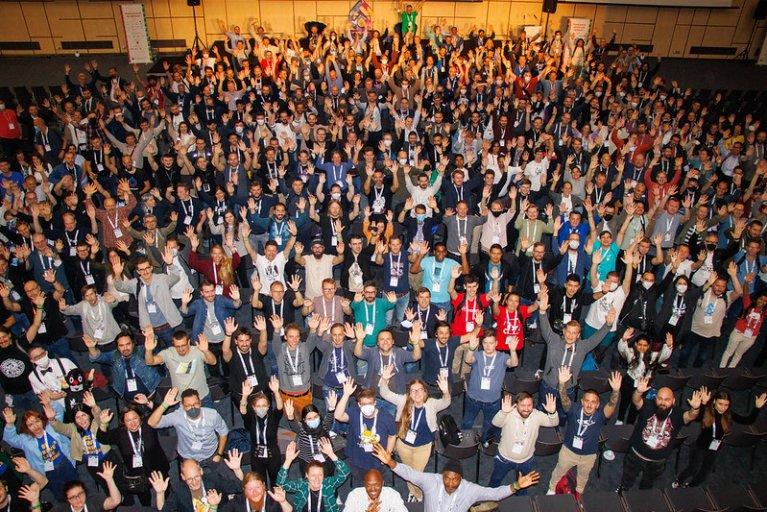
This is due in part to the large community behind Drupal, which is considered the second largest in the world after the open source framework Linux. Through years of dedication, this community has made a significant contribution to growth and adaptation to the requirements of digital systems.
Even founder Dries Buytaert commented on this development at the 20 year anniversary, expressing how much Drupal has been able to evolve over the years with the following words:
„At the time, I had no idea that Drupal would someday power 1 in 35 websites, and impact so many people globally…“
Why Drupal Excels in the Enterprise Context
What has distinguished Drupal over the years is not a single feature, but an attitude: flexibility instead of rigid rules, structure instead of limitation.
Companies use Drupal today for:
- international corporate websites
- platforms with millions of users
- e-learning portals for internal training
- intranet systems and partner portals
- headless architectures and API first setups
- digital experience platforms DXP
- highly integrated systems with CRM, ERP, PIM, or commerce solutions
Drupal adapts to existing processes, not the other way around. This is exactly what makes it attractive for organizations that think about digital products strategically.
Drupal and AI: Open Source as an Innovation Accelerator
One particularly exciting chapter in Drupal’s current development is its approach to artificial intelligence. Here, Drupal takes a leading role among open source frameworks.
Why is that?
In Drupal, AI applications are not seen as isolated features, but as an integrated part of digital workflows. AI capabilities can be embedded modularly, configured transparently, and used responsibly, both in content generation and personalization as well as in automation and analysis. Unlike many AI tools on the market that are offered as standalone SaaS solutions, AI applications in Drupal run directly within the system, providing greater control, cost efficiency, and data sovereignty.
The decisive advantage: Open source enables open innovation. New AI approaches are not developed behind closed doors, but together with the community. This ensures:
- faster development
- greater transparency
- better control over data and models
- less dependency on individual vendors
Especially for companies that want to use AI strategically and sustainably, this is a key factor. With our tool FlowDrop, we have reached a decisive milestone in the field of agentic automated workflows.
Drupal Today: More Powerful, More Accessible, Faster
Today, 25 years after its founding, Drupal is not only more flexible, but also measurably stronger. And this is true across several areas that are particularly relevant for companies today.
API First and Headless Ready
Drupal is far more than a classic CMS. Thanks to its consistent API first approach, it is ideally suited for headless and composable architectures. Content can be managed centrally and delivered flexibly across a wide variety of touchpoints, from websites and apps to digital services. This makes Drupal the content hub of modern digital strategies.
Security and Long Term Stability
Drupal has enjoyed an excellent reputation in the area of security for many years. A dedicated security team, clear release cycles, and transparent processes ensure a high level of reliability. For companies, this means predictable evolution instead of short term technology decisions.
Multisite, Multilingualism, and Internationalization
Global organizations benefit from Drupal’s ability to support complex multi brand and multi country setups. Multilingual capabilities, role concepts, and differentiated editorial workflows are deeply embedded in the system, without compromising maintainability or governance.
Editorial Efficiency and User Experience
Drupal has also evolved significantly from the perspective of editors. Modern editors, structured content, and flexible workflows enable content teams to work more efficiently, regardless of the technical complexity in the background.
Accessibility as a Standard, Not an Add On
In recent years, Drupal has made major progress in accessibility. Accessibility is no longer a nice to have, but is deeply embedded in the system, from semantic markup and keyboard navigation to optimizations for screen readers. This is not only socially and economically relevant due to better structured data, but also supports compliance with current legal requirements such as the European Accessibility Act EAA.
Enterprise Level Performance
With recent versions, especially through ongoing improvements up to Drupal 11.3, performance, caching, and core architecture have been significantly enhanced. The result: up to 33 percent faster load times, improved scalability, and a stable foundation for large, highly frequented platforms.
In short: today, Drupal is more than ever designed for high system loads and for meeting users’ current expectations of a state-of-the-art user experience.
Why We Rely on Drupal at Factorial
For many years, we at Factorial have consistently relied on Drupal in our digital projects. Not out of habit, but out of conviction.
Drupal aligns with our mindset:
- no license costs: investments flow into quality, not dependencies
- full control: the ability to manage code, data, and architecture ourselves
- long term security through a stable, community driven ecosystem
- maximum adaptability instead of off the shelf standard solutions
But above all: we are not just users of Drupal, we are part of its ongoing development.
Our ambition is to use Drupal at the highest level. This is made possible by a team that is deeply rooted in the community and actively involved in the further development of the framework, technically, conceptually, and strategically.
“25 years of Drupal, and we are proud to have been actively contributing to this success story for many years. As contributors, we help shape innovation and continuously drive Drupal forward. To this day, Drupal continues to impress us with its openness and its strength for individual software solutions. That is precisely why, even after 25 years, we firmly believe in the impact of Drupal and open source software.”
Stephan Huber, Managing Partner
This community involvement is not an end in itself for us, but a promise of quality to our clients. They benefit every day from the fact that we are maintainers of globally used Drupal modules, understand Drupal’s full potential, and are well connected within the community.
25 Years of Drupal: A Commitment to Open Source
After 25 years, Drupal is not a finished product, but a living system. It grows with new requirements, learns from emerging technologies, and remains true to its open source values.
For us at Factorial, one thing is clear: if companies want to build digital products that are sustainable, scalable, and strategically relevant, they need a framework designed precisely for that purpose. Drupal was built for this 25 years ago. And today, more than ever, it still is.