November 2, 2026
Agentic workflows: The AI is right. Mostly.
Where agentic workflows can fail, and how AI automation makes it into production.
The demo went perfectly. Three weeks later, accounting asks: What happens when the agent gets it wrong? Nobody has an answer. And that is where it’s decided whether a project ever makes it past the pilot.
Workflow automation: Reliability is no accident
A mistake in marketing copy is annoying. In an invoice approval, a diagnostic summary or a regulated process, it’s a risk.
Business processes demand two things at once. There are steps that must always run the same way. Above a certain amount, an order needs approval. A record with a certain status moves into the ERP. A regulatory check follows a fixed scheme. Creativity has no place here.
And there are tasks where language models, the technology behind AI assistants, play to their strengths: summarising texts, classifying requests, understanding language, spotting anomalies.
It becomes a problem when a tool treats both the same. Then a model decides where a rule would do. Or companies have to choose between flexibility and reliability, even though their processes need both.
AI agents: An agent is not a process
Behind agentic workflows lies a strong idea: AI doesn’t just take over individual tasks, it makes decisions and coordinates steps on its own. In demos, that’s convincing. In everyday operations, the purely agentic approach hits a structural limit.
Language models work with probabilities. The same input can lead to different results. For a summary, that’s fine. For a calculation rule, an approval threshold or a mandatory procedure, it isn’t.
Leave such steps to a model and you get inconsistent results, decisions that are hard to trace and processes nobody trusts. That’s no criticism of AI. It’s a sober description of what it was built for.
Then there are the costs. If you rely on AI at every step, you pay at every step: billing is per token or per call, even for simple routing. And errors add up. Even at 95 percent accuracy per step, a workflow with five steps ends up at around 77 percent overall, as Volkan Jacobsen, Managing Partner at Factorial, calculates.
Agentic workflows with FlowDrop: The AI has a say, the rule decides
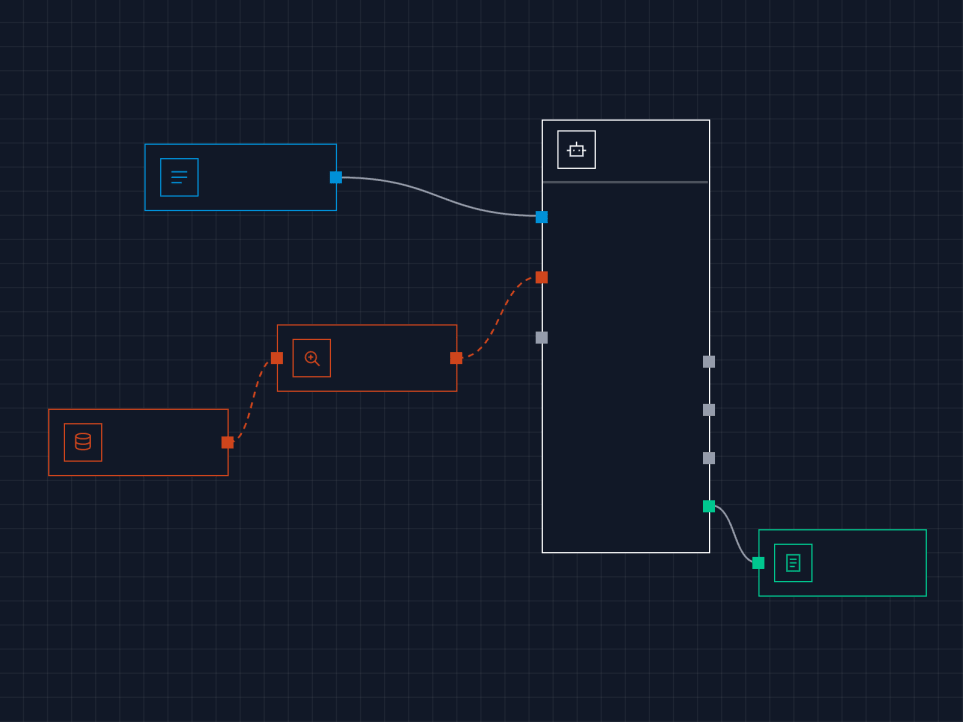
This is where FlowDrop comes in: at the level of architecture. The visual workflow editor for AI agents is an open source project by Factorial. Language models and fixed business rules sit side by side as equals. It can be used in three ways: fully inside Drupal, embedded in your own application or hosted by Factorial.
One step can be a model call, for a summary or a classification, for example. The next can be a rule that is always evaluated the same way, no matter what the model delivered before.
The difference: FlowDrop doesn’t hand the entire process to an agent. The project follows the principle “predictable over autonomous”. Clearly defined flows deliver results that can be repeated and verified. Every connection in the workflow is visible, and every run leaves a permanent record.
The principle behind it: The model proposes an action and explains why. FlowDrop carries it out. This creates controls outside the model that it can’t argue its way around. An agent can only use the actions enabled for it. Every call can be checked against your own rules before and after it runs. And anything that really matters goes past a human first. An instruction to the model is a request. A rule in the workflow is a control.
What a workflow means is defined by an open specification with 399 rules. So the same workflow behaves the same everywhere, whatever system it runs on.
Three properties make this relevant for businesses:
- People are part of the plan. Workflows pause while running, collect approvals, choices or form input and continue automatically as soon as someone responds. In Drupal, a record shows who approved what and when. Nothing goes live without approval.
- Your data stays yours. Workflows live in your own database, and FlowDrop itself doesn’t access the data. In Drupal, everything runs inside your own website, with no FlowDrop service outside it. Beyond Drupal, FlowDrop can be used hosted or run by yourself, including on your own servers (on premises). In regulated industries in particular, that’s an important criterion.
- Open source means control. The editor is MIT licensed and free to use, including in commercial projects. It connects to any system that offers a standard web interface, so no new silo is created. No dependency on a vendor who changes their terms tomorrow.
For AI systems the EU AI Act classifies as high risk, it requires human oversight, record keeping and transparency. In FlowDrop, these obligations have a concrete home: an approval step the system enforces and a decision log in your own database.
AI process automation in practice: One inbox, two paths
A company wants to automate incoming customer requests. Each request should be identified, routed to the right team, escalated if it shows certain characteristics and documented in the CRM.
In a purely agentic approach, a model decides everything, including routing and escalation. Whether a request reaches the right team then depends on how the email is worded. That’s hard to trace.
With FlowDrop, the same process looks like this:
- The model classifies the request. That’s exactly what it’s good at.
- Fixed rules route the request. Same condition, same result.
- The escalation threshold is a business rule, not a judgement by the model.
- In borderline cases, the workflow pauses and waits for a person to decide.
- The CRM entry follows automatically.
The result is a process you can trust. Not because the AI makes no mistakes. But because the architecture catches its mistakes where they must not happen. The team handles the cases that truly need judgement. The workflow does the rest.
AI in business: Impressive is good, running in production is better
Yesterday’s question was: Can we integrate AI into our processes? The answer has long been yes. Today’s question is: How do we build workflows that hold up in production? Reliable, traceable, extensible. And without dependencies that catch up with us two years from now.
FlowDrop doesn’t solve every problem. It makes a principle buildable: AI where it’s strong. Fixed logic where reliability matters. Both in a visible, configurable workflow that fits into your existing infrastructure instead of replacing it. That way, AI becomes a building block of your digital ecosystem rather than yet another system next to it.
Factorial is the main contributor to FlowDrop and also offers enterprise customers a hosted version with custom integrations. Whether in Drupal, as an editor in your own application or hosted: we know the system inside out.
Our approach doesn’t start with the tool, but with the question of which problem AI should solve. Find out more about our AI offering.
Which of your processes would be the first where you want to know exactly where the AI decides?