Mai 28, 2026
From Pilot to Production: Why Pharma Is Still Stuck in Experiment Mode – and What Makes the Difference
Author: Volkan Jacobsen, Managing Partner
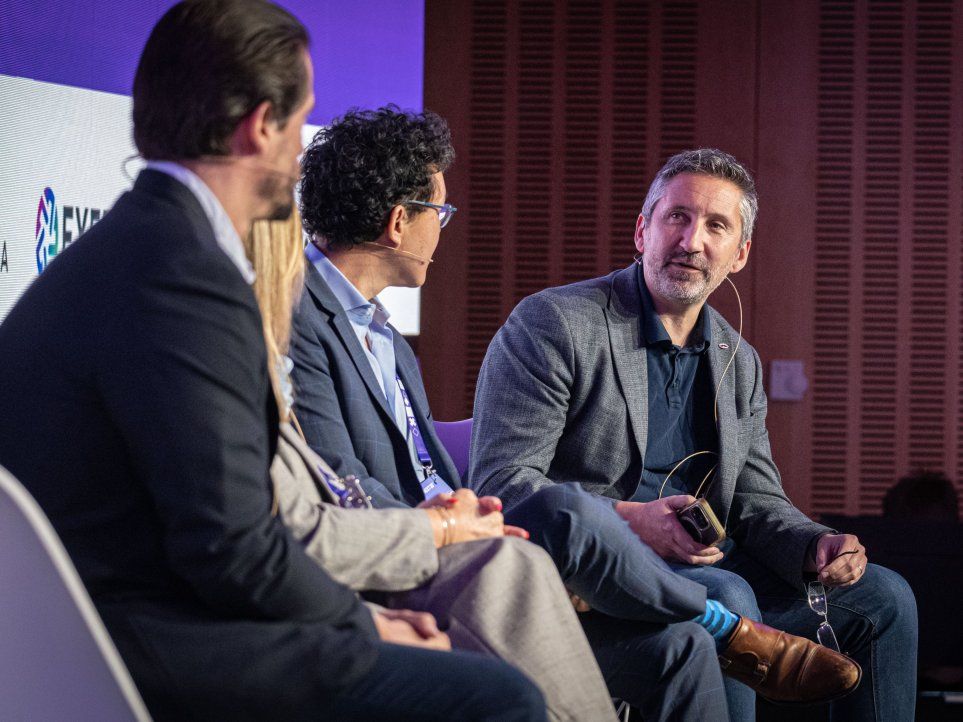
The “Missing Middle” between strategic vision and operational reality was the defining theme of the NEXT Pharma Summit 2026 in Dubrovnik. Our impressions from two days – what’s driving the industry, where the most honest debates took place, and what it means for digital platforms in pharma.
Medical knowledge doubles every 73 days. The infrastructure isn’t keeping up.
In 1950, medical knowledge doubled every 50 years. By 1980, every 7 years. By 2020, every 73 days. In the age of AI, the curve will steepen further. This is the context in which life sciences organisations are making digital decisions today: under time pressure, with growing volumes of data, in regulated environments that leave no room for error.
And it’s precisely this context that made one question so urgent – a question that divided the audience at the NEXT Pharma Summit in Dubrovnik, yet ultimately produced a clear winner.

Build, Buy or Partner? The audience has voted.
Build, buy or solve it through partnership? In a live vote, the audience voted overwhelmingly for partnership – not as a shortcut. As a deliberate strategy.
The logic is straightforward: the organisation’s own orchestration layer, its data, and its user experience should remain in its own hands. Everything else – speed, scale, specialisation – can be brought in through partners. Sovereignty and agility are not mutually exclusive. They simply require a clear line of demarcation.
”Own your orchestration layer, your data, your user experience – but leverage partners to accelerate.” That was the consensus in Dubrovnik, and it describes fairly precisely where the next generation of digital pharma infrastructure is being built.
The Missing Middle: The bottleneck isn’t a lack of ambition.
What we brought back from this year’s NEXT Pharma Summit aligns with what we hear consistently in conversations with life sciences teams: the bottleneck is rarely a lack of will to transform digitally. Infrastructure is the problem.
Jennifer Cleall from Ferring Pharmaceuticals introduced the term Missing Middle to capture this: the gap between strategic vision and operational reality. Her diagnosis: transformation rarely fails because of the technology itself, but because of the difficulty of translating global strategy into local execution. Pilots that don’t scale. Platforms that don’t converge. Teams operating in parallel at different stages of digitalisation – because the technical foundation doesn’t support the direction.
In the session “From Pilot to Production: Scaling Agentic Workflows in Pharma”, Stefan Miljković made the same point from a technical perspective: agentic workflows function in controlled environments, but the leap out of pilot stage rarely succeeds. What matters, he argued, is not the AI model itself, but the orchestration layer beneath it – the system that actually governs the workflows. The real obstacle almost always lies below the surface of the AI question, in the platform architecture underneath.
The infrastructure question: What actually enables scale.
Agentic workflows are not a feature you bolt onto existing systems. They are a stress test for the infrastructure beneath them. Scaling them requires clean data structures, defined governance, and a platform architecture that structurally accommodates extensions – rather than treating them as exceptional projects.
This is the point at which partnership becomes strategic. Not every organisation can – or should – build every layer of this infrastructure itself. What they must own: decision-making authority over how these layers interact. What they can source from partners: the speed with which those layers are built.
This is precisely why we built our partnership with Langdock – GDPR-compliant, EU-hosted, model-agnostic. A solution that closes the missing layer between AI potential and real-world adoption in day-to-day workflows, without surrendering data sovereignty.
The missing layer is rarely the AI itself. It’s the infrastructure that translates AI into real-world processes.
How Factorial can help.
We have been building digital platforms for life sciences organisations for years – from content infrastructure to the integration of complex systems. What the Summit confirmed for us: the questions companies were asking in Dubrovnik are the same ones we encounter in our own projects. How do I structure my data so that AI applications can build on it? How do I build a platform that scales without giving up control? Where is the right entry point?

What we’re taking home from Dubrovnik.
The NEXT Pharma Summit 2026 was not a conference for big announcements. It was a year for honest diagnoses. An industry that has learned to scrutinise its own pilots. That openly acknowledges 95 percent of AI projects fail – and asks why. That in the Build/Buy/Partner debate is no longer discussing theory, but making practical decisions. The technology is available. The willingness is growing. What matters now is the infrastructure decision – who makes it, when, and with which partners.
If you recognise the Missing Middle in your own organisation: we’d be glad to talk through what a first concrete step might look like.