7 October 2026
Design Systems in the Age of AI: A Grammar for Machines
Why design systems matter more than ever right now, and what the push of a button at the German knowledge magazine GEO has to do with it.
Author: Natalia Alves, Data & AI Manager
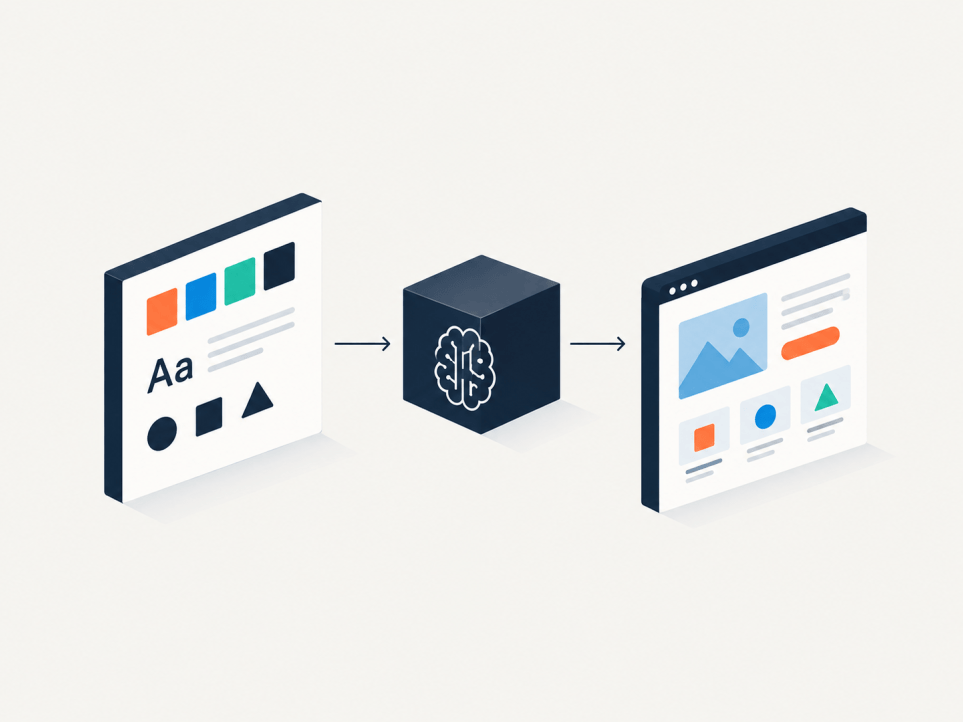
Ten teams are working on the same platform in parallel. Each team has access to an AI that builds components in minutes instead of days. After a week, the platform has four different definitions of a button, three variations of spacing and no shared colour logic anymore. The content is good. But the brand is falling apart.
This is exactly what is happening in many digital teams right now. The trigger is a tool that is fast and efficient: AI. Layouts by prompt. Components at the push of a button. Variants in seconds. What used to take days is now a matter of minutes. The problem: without a shared foundation, speed mainly produces inconsistency.
Moving faster while still speaking the same language. Is that possible?
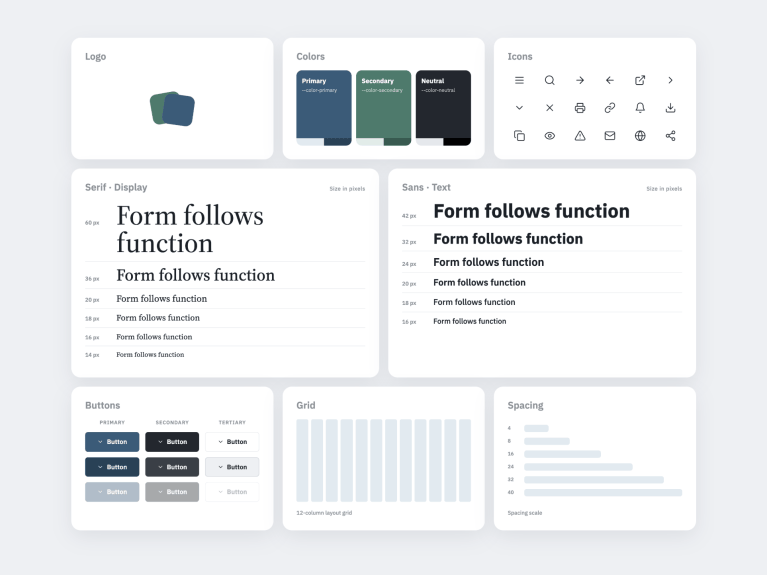
Design systems are not a new concept. In complex digital projects, they have been considered best practice for years: a shared library of components, design tokens, styles and rules that ensures different teams, products and brands speak a recognisable visual language.
What has changed is the context. AI powered tools are changing how quickly design output is created and who creates it. Developers who never used to make design decisions now generate interface suggestions. Product teams sketch screens without consulting designers. That is the logic of modern toolchains. But speed without direction is not efficiency.
More variants, less brand: the AI paradox in design
A language cannot simply be sped up. More words can be produced, but when the grammar is missing, the result is not text. It is noise.
The same principle applies to AI supported design. AI tools work generatively: they deliver possibilities, not decisions. Without a design system that sets clear rules (which colours, which spacing, which typography, which components in which context), every form of AI assistance becomes an entropy machine. It produces more variants, but no coherent brand.
The design system is therefore the grammar in which AI is meant to speak. Without it, prompt engineering is not a lever for scale. It is digital noise with a glossy finish.
AI exposes weaknesses
The real question is not whether a design system is needed. Complex digital products with multiple teams, brands or channels need one. The question is: is it good enough to provide direction once AI tools start producing faster than people can review?
If a design system is poorly documented, not anchored in the technology and not lived in everyday work, AI will not make it better. It will make its weaknesses more visible, because deviations appear faster and are harder to trace. A strong design system, on the other hand, becomes a multiplier. Not because AI magically “thinks in the system”, but because the teams working with AI have a clear guideline against which they can review, adjust and anchor output.
Infrastructure only gets noticed when it’s missing
Design systems were never sexy. They are part of the infrastructure. In a world where digital output is becoming ever faster, ever cheaper and ever more generative, a good design system protects brands from disappearing in their own digital channels. Not in competition, but within themselves: through inconsistency, drift and the gradual erosion of visual identity.
AI needs grammar. And it has to be built before it is needed.
Scaling through boundaries: what a good design system unlocks
A good design system does not restrict. It creates the space in which speed can actually pay off. When colours, spacing, components and rules are already defined, nobody has to renegotiate with every prompt what belongs to the brand and what doesn’t.
Teams can experiment with AI without ending up with arbitrariness. Developers can sketch interfaces, product teams can generate screens, and the brand still remains recognisable, because the decisions have long been made. This is exactly what makes a design system so valuable in the age of AI: it turns speed from a risk into an advantage. A concrete example shows what this looks like in practice.
300 components, one button, two brands: what RTL Publishing and GEO show
That this is not a theoretical argument is shown by the relaunch of GEO and GEOlino, which Factorial delivered together with RTL Publishing. The groundwork was laid by the relaunch of stern.de, whose modular architecture was designed from the start to serve GEO and Capital as well. At the centre was a modular design system with more than 300 components and around 200 styles, built consistently for scale. The result is not a static library, but a living system: once the basic layout of a page is in place, it can be switched at the push of a button, for example from the desktop version of one brand in light mode to the mobile version of another brand in dark mode. Colours, typography, sizes and layouts are adapted along with brand specific details such as logos and teaser variants.
What this means in practice: GEO and GEOlino relaunched in around ten weeks. New brands can be launched on the same foundation much faster, with reduced effort in design, development and testing.
That is not an efficiency trick. It is architecture.
Ten teams, one language
Governance is the decisive lever for scaling workflows in digital ecosystems in a controlled way when working with AI. We have already written about why generative AI fails without clear governance rules elsewhere on our blog.
Ten teams, one AI and no shared set of rules: the result is not speed, but noise. It works the other way around when grammar comes before the tool. The relaunch of GEO and GEOlino shows that two brands can be relaunched on a shared foundation in weeks rather than months, without either of them losing its identity.
That is the real achievement of a design system in the age of AI. It doesn’t slow speed down. It makes it manageable. The question is therefore no longer whether AI is changing the work of design teams. It already is. What matters is what the next wave of output runs into: a set of rules that is already in place, or a gap.
Grammar before speed
How robust is a design system once AI starts designing along with it? A joint look at components, design tokens and rules quickly shows where the system holds and where it needs sharpening.