E-learning in the financial sector
Training as a place, not a booking
Industry: Banking | Financial sector

A learning platform that raises service quality
Good training costs time and money — and employees still end up with content that misses their reality. Training an organisation with thousands of staff across very different roles is a considerable challenge: personalising for every audience is expensive and slow, while a standardised course catalogue for everyone is cheap but far too generic for individual needs. Most providers reluctantly go with the second option.
A trainee, however, needs different content than a wealth adviser. And a member of the executive board needs something different again. A classic course catalogue can’t reflect that. In principle it would take three separate websites, three editorial teams, three permission structures. But does that have to mean building a new learning platform every time?
Ideally, what’s needed is one platform on which departments can create new, self-contained learning environments themselves — each with its own content, its own access rights and its own community.
Classroom training: the standard that stood in the way of scale
For years, the training offering of our client in the banking and financial sector ran mainly as classroom formats and web based trainings — functional, but not built to grow with the organisation or to be assembled individually for different audiences.
Out of the collaboration came a platform with one clear goal: to support employees from interdisciplinary fields at different points in their careers with digital offerings that match their needs — and not as passive recipients of content, but in active exchange with other learners.

Three tensions defined the starting point
One audience, many roles
Trainees, wealth management, executive bodies — every group needed its own content, its own access, its own visibility in search results. These requirements were hard to map with the existing setup.
Built on what exists
Access and permissions ran through an identity and booking system already established across the organisation. Every new learning environment had to connect to it technically, without maintaining master data twice.
A product, not a project
The client licenses and sells access to the training offering to further institutions within its own network. The platform therefore had to be built from the start to grow with every new client, instead of being adapted individually for every new institution.
One platform made of reusable learning spaces
These three fields led to the actual question. Not what content the platform should deliver, but how one platform can map audiences, permissions and additional institutions at the same time. Analysing the roles, the existing booking and identity structures and the planned licensing pointed to a building block that can be created as often as needed, rather than a platform adapted case by case.
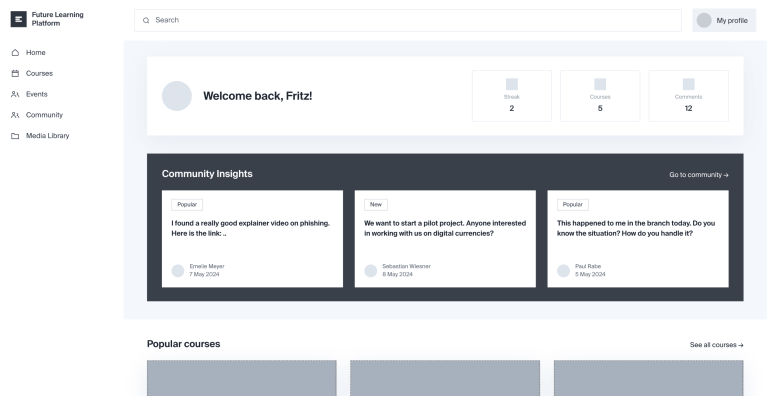
Together with the client, we developed a learning experience platform built on the Lernbar as its central building block: a self-contained, editorially designed learning space that product managers can create and maintain independently of one another, each with its own community.
Five building blocks that carry this architecture
- A modular editorial system. Instead of rigid templates, editors work with reusable content types — from simple pages through accordions and personalised welcome blocks to a player for SCORM and xAPI learning content and embedded podcasts.
- Role and permission management instead of one-size-fits-all access. Access, bookings and content visibility are tied to roles and run through the connection to the organisation’s existing identity system — content can appear in several Lernbars at once, without users seeing more than the areas they are entitled to.
- Community instead of a one-way street. Every Lernbar comes with its own community, with its own start page, moderation functions and multi-channel communication via a Mattermost integration — training becomes a place of exchange, exactly as intended from the start.
- Search that thinks along. Search within a Lernbar takes tags and content type into account and shows only the results a user is entitled to see — even when the underlying content exists in several Lernbars at the same time.
- Evaluation and analysis from day one. Usage data flows into an analytics setup based on Google Analytics and Looker Studio, so the offering can be adapted continuously to actual needs and to how people learn.
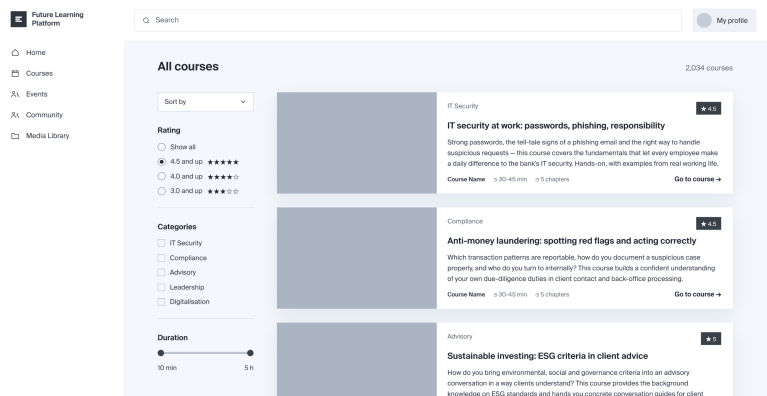
After the MVP launch, the platform was extended continuously: a media library for missed events and content to catch up on, a chatbot, multilingual community functions and the ability to run several Lernbars in parallel — every extension proof that the architecture delivered exactly what was intended at the outset: the ability to grow with the organisation, without being rebuilt for every new requirement.
A scalable learning platform in numbers
1 central building block
The Lernbar as a reusable base unit for learning content and community — designed and maintained independently.
8+ content types
From accordion through learning content, podcasts, events and personalised welcome to the SCORM/xAPI player — modular building blocks instead of rigid pages.
3 permission dimensions
Roles, booking and visibility in search results interlock, aligned with the organisation’s existing identity system.
Mattermost community
Every Lernbar brings its own community — exchange between learners instead of one-way content delivery.
Media library
Missed events and content remain available to users afterwards.
Chatbot
An implemented chatbot answers recurring questions directly on the platform, instead of passing every enquiry on to support.
Want to scale training without building from scratch every time?
In a discovery workshop, we’ll show you how a Lernbar architecture maps your audiences.